
Have you ever watched an athlete struggle and thought, “What happened to their talent?”
Maybe they were sharp in practice but froze in competition. Maybe they looked confident last season but now seem distracted, tired, or frustrated. Maybe they are working harder than ever but getting less from their effort.
Here’s a different way to look at it:
Talent may not have disappeared. The available space did.
That idea is at the center of Peak Mental Performance for Athletes, the first book in Eric Batchler’s Capacity series. The book’s practical framework helps athletes, coaches, and parents understand what happens when stress fills the cup: and what to do next.
The Cup Theory: Potential Isn’t the Same as Capacity
Picture a cup.
The cup represents an athlete’s potential: the skills, experience, athleticism, and ability they could bring to the moment.
Now picture sand being poured into that cup. The sand represents stress.
When the cup has plenty of open space, an athlete can think clearly, respond to mistakes, and access the skills they have practiced.
When the cup is nearly full, even a small disruption can create a big reaction.
A bad call. A missed assignment. A tough opponent. A parent’s comment. One more demanding practice.
And when training load is added to a cup already full of sand, the result may be burnout, failure, shutdown, or a performance that looks far below the athlete’s normal ability.

The goal is not always to demand more.
Sometimes the goal is to create more room.
What Fills an Athlete’s Cup?
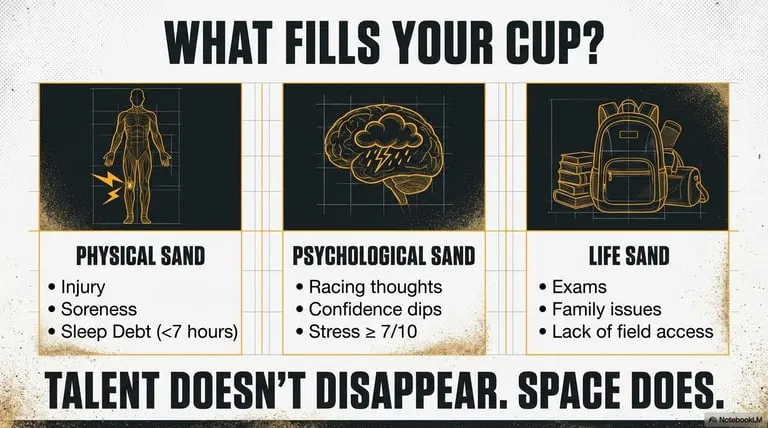
The Capacity framework organizes stress into three broad categories: physical sand, psychological sand, and life sand.
1. Physical Sand
Physical sand includes the demands placed on the body.
This might include:
- Hard training sessions
- Too many competitions
- Soreness or injury
- Travel
- Poor nutrition
- Sleep debt
- Inadequate recovery
An athlete who is sleeping five or six hours, carrying an injury, and going from one intense session to another may not need a lecture about effort.
They may need recovery.
Physical stress can affect more than the body. Fatigue can reduce attention, patience, confidence, and emotional control. That makes ordinary competitive pressure feel much heavier.
2. Psychological Sand
Psychological sand is the mental and emotional pressure an athlete carries.
It can include:
- Fear of failure
- Racing thoughts
- Perfectionism
- Confidence dips
- Worry about playing time
- Pressure to meet expectations
- Team conflict
- Constant self-criticism
This type of stress can be difficult to see. An athlete may look physically ready while mentally carrying a full cup.
They may be thinking about the last mistake, the next mistake, what the coach is thinking, or what everyone in the stands might say.
That leaves less attention for the actual task.
3. Life Sand
Life does not stop because an athlete has a game.
Life sand may include:
- Exams and school deadlines
- Family issues
- Work responsibilities
- Financial stress
- Relationship problems
- Moving or changing schools
- Lack of transportation or field access
- Social pressure
These stressors are not excuses. They are context.
If we ignore them, we may misread the athlete’s behavior. A player who seems unfocused may not lack discipline. They may be trying to compete while carrying problems no one has asked about.
That is why effective mental performance coaching looks at the whole person, not just the scoreboard.
The First Step Is a Capacity Check
Before asking an athlete to push harder, ask a better question:
What is filling the cup today?
A simple capacity check can take less than a minute. Ask the athlete to rate each category from 0 to 10:
- Physical stress: ___ / 10
- Psychological stress: ___ / 10
- Life stress: ___ / 10
Then ask:
- What is taking up the most space?
- What part of this can we change today?
- What support would make today more manageable?
- What is the most important task for the next hour?
This is not about finding a perfect score.
It is about noticing the load before the cup overflows.
The Capacity Scorecard can also help athletes, coaches, and families start that conversation.
Reduce the Manageable Sand
Not every stressor can be removed immediately.
An injury may require time. A difficult exam cannot always be postponed. Competition pressure is part of sport.
But many stressors can be reduced, clarified, or organized.
Athletes Can:
- Protect a consistent sleep routine
- Tell a coach when soreness is becoming pain
- Replace vague worry with one specific question
- Prepare equipment and meals ahead of time
- Limit unnecessary phone or social media pressure before competition
- Use process goals instead of outcome goals
- Schedule recovery instead of treating it as optional
- Ask for help before reaching a breaking point
Small changes matter because a cup does not usually overflow from one giant event.
It often overflows from many manageable stressors that were never addressed.
Coaches Can:
- Check workload instead of assuming more is better
- Make roles and expectations clear
- Give athletes permission to ask questions
- Avoid turning every mistake into a character judgment
- Build pressure into selected practices: not every practice
- Teach mental skills when athletes are calm, not only when they are struggling
- Notice changes in behavior, energy, and communication
Mental toughness for athletes is not the same as pretending nothing affects them.
Real toughness includes awareness, adjustment, and the ability to use support.
Parents Can:
- Ask, “How full is your cup today?” instead of “Why didn’t you play better?”
- Listen before offering solutions
- Keep post-game conversations simple
- Avoid adding outcome pressure in the car ride home
- Help protect sleep, meals, transportation, and recovery
- Praise preparation, communication, and response to adversity
Parents do not need to become sports psychologists.
They can make a major difference simply by becoming a source of less sand.
A Simple Competition Reset: Anchor, Reframe, Reset
When an athlete is already competing, there may not be time for a long conversation.
That is where the ARR sequence from Peak Mental Performance for Athletes can help:
Anchor. Reframe. Reset.

1. Anchor: Return to the Present
Use one physical action to interrupt the spiral.
Try:
- One slow exhale
- A tap on the hip or thigh
- Feeling both feet in the ground
- Relaxing the shoulders
- Looking at one fixed point
The anchor is not magic. It is a signal to the body and brain:
Come back to this moment.
2. Reframe: Use Factual Self-Talk
Replace the emotional story with something accurate and useful.
Instead of:
“I’m falling apart.”
Try:
“That play is over. I can still execute the next one.”
Instead of:
“I can’t make another mistake.”
Try:
“My job is to make one clear decision.”
Instead of:
“Everyone is judging me.”
Try:
“The next task is the only thing I can control.”
This is not forced positivity. It is factual self-talk.
The goal is to use words that are believable enough to guide action.
3. Reset: Choose One Micro-Goal
Finish the reset with one controllable action.
Examples:
- See the ball early
- Finish through the target
- Win the next footrace
- Communicate on defense
- Follow the next pitch
- Hold the finish
- Take the next breath
The athlete does not need to solve the whole game.
They need to return to the next useful action.
That is mental training for athletes in a form they can actually use under pressure.
Building Capacity Is a Daily Process
Capacity is not built only during a championship moment.
It is built through daily choices:
- Recovering well
- Practicing attention
- Learning how to respond to mistakes
- Having honest conversations
- Creating supportive team environments
- Developing routines that hold up under stress
- Gradually practicing pressure instead of avoiding it
This is also where sports psychology for athletes becomes practical. Visualization, breathing, routines, goal setting, self-talk, and pressure practice are not just concepts to discuss. They are skills to rehearse.
You want the reset to feel familiar before you need it.
Fix the Process, Not the Player
When performance drops, the easiest conclusion is often, “The athlete needs to be tougher.”
Sometimes the athlete does need a new skill.
But sometimes the system around them needs to change.

Ask:
- Is the training load appropriate?
- Is the athlete sleeping?
- Are expectations clear?
- Is the environment safe enough to make mistakes?
- Is the athlete carrying a problem that needs support?
- Are we adding pressure to a cup that is already full?
A mental performance coach for athletes can help identify these patterns and turn them into a practical plan. Through one-on-one coaching, team workshops, and staff support, the focus is not simply on making athletes work harder.
It is on helping them protect the space that allows their talent to show up.
Talent Doesn’t Disappear. Space Does.
The next time an athlete looks unlike themselves, pause before assuming the talent is gone.
Look at the cup.
What physical sand is present? What psychological sand is present? What life sand is present?
Then ask what can be removed, reduced, supported, or addressed.
Sometimes the best performance intervention is another repetition.
Sometimes it is a better recovery plan.
Sometimes it is one honest conversation and a simple reset before the next play.
If you want to explore the Capacity framework in more depth, you can learn more about the Capacity series or pick up Peak Mental Performance for Athletes.
And if this idea helps you or your athlete, share it with a coach or parent who might need it. A quick review of the book is welcome, too!
Stay tuned for more practical tools for focus, resilience, confidence, and performance under pressure. Reach out anytime( we’re always glad to talk mental performance!)
Leave a Reply