
You know the feeling.
The bar is loaded. Your warm-up moved well. You have done the work. But when it is time to lift something heavy, your mind suddenly hits the brakes.
Maybe you hesitate before the unrack. Maybe the weight feels heavier than it should. Maybe one difficult rep turns into a story about your strength, your progress, or your future.
The instinct is usually simple: try harder!
Sometimes that helps. But not always.
As explored in Peak Mental Performance for Athletes, the better question may be:
How much capacity do I have available right now?
The Mental Wall May Not Be a Motivation Problem
A mental wall is not always a sign that you are lazy, soft, or lacking mental toughness.
It may be information.
Your body and mind are constantly managing stress. Training is one source of stress, but it is not the only one. School, work, family conflict, poor sleep, pressure from teammates, fear of failure, and uncertainty can all affect how much capacity you bring into the weight room.
This is where the Capacity/Cup Theory framework helps.
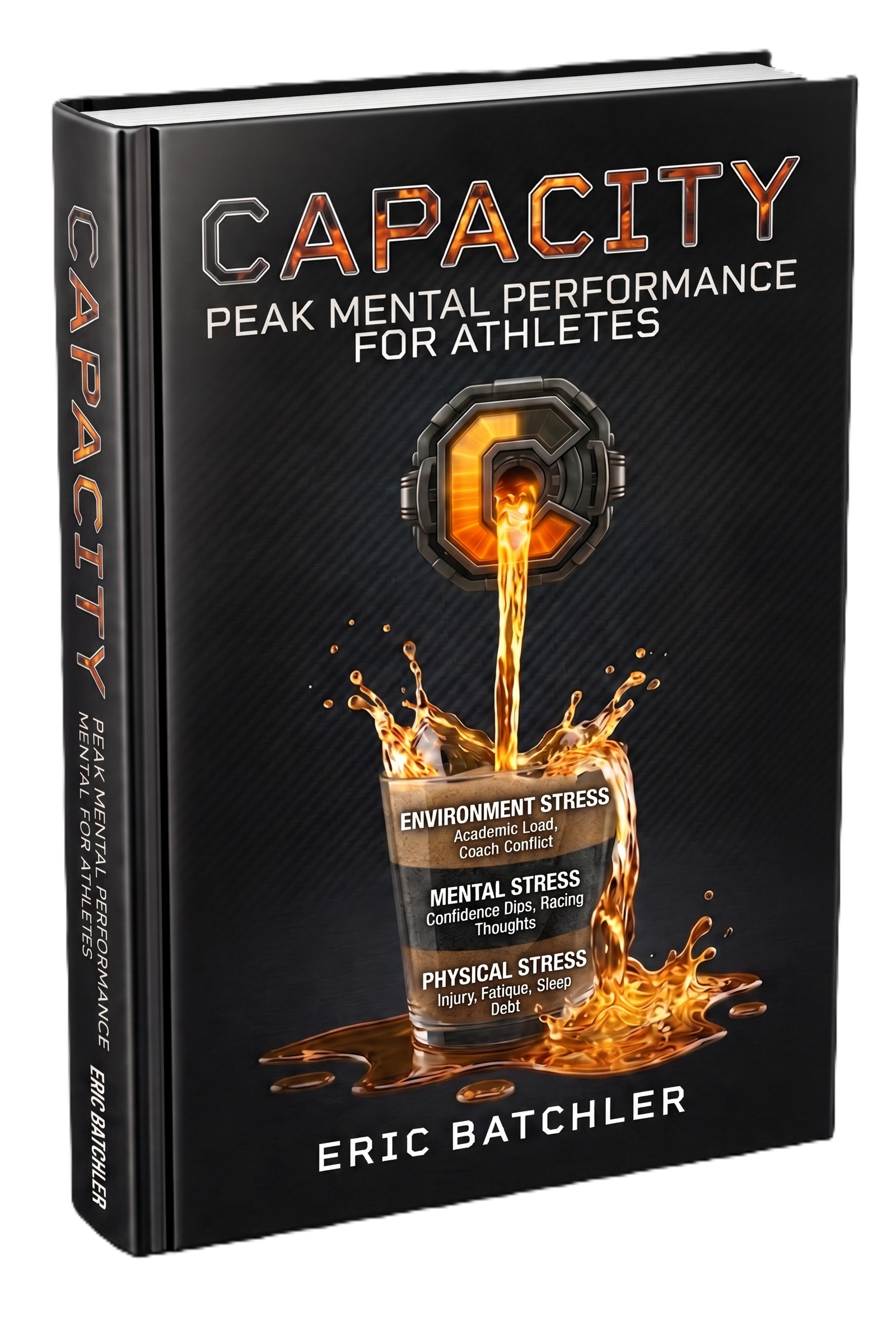
Imagine that your potential is a cup. Stress is sand filling that cup. The more sand inside, the less room you have available for training, focus, recovery, and execution.
Adding more weight to a nearly full cup does not automatically make the cup bigger.
It may simply cause the cup to overflow.

The Three Types of Sand Filling Your Cup
Before you decide to force your way through a lifting wall, take a quick look at what may be filling your cup.
1. Physical sand
Physical sand includes the stress your body is carrying.
That could mean:
- Hard training sessions stacked too closely together
- Muscle soreness that has not cleared
- A recent injury or illness
- Lack of sleep
- Poor hydration or nutrition
- Travel, competition, or a demanding schedule
Physical fatigue matters. A tired athlete may still be willing to work, but willingness does not erase recovery needs.
2. Psychological sand
Psychological sand includes the thoughts and emotions that consume attention.
Fear of missing a lift can create hesitation. A previous injury can make you doubt a movement. Comparing yourself to a stronger teammate can turn a normal training day into a test of your worth.
You may be physically ready to lift, but mentally busy trying to avoid failure.
That mental noise uses capacity!
3. Life sand
Life sand comes from everything outside the gym.
Family stress. Exams. A job. Relationship problems. Financial concerns. A difficult conversation. Social pressure. Even excitement about an upcoming event can take up mental space.
The weight room does not exist in a vacuum. You bring your whole life with you.
That is why the same weight can feel manageable one day and overwhelming the next.
Productive Discomfort or Overload?
Mental toughness training is not about ignoring every warning signal.
There is a big difference between productive discomfort and overload.
Productive discomfort may feel like:
- Muscular effort and fatigue
- Controlled breathing
- A challenging but familiar movement
- Temporary doubt that you can answer with a clear cue
- A difficult rep completed with stable technique
- Discomfort that stays within your planned training range
Overload may look like:
- Sharp, sudden, or localized pain
- Technique breaking down repeatedly
- Loss of control during the movement
- Unusual dizziness, weakness, or confusion
- Fear that continues to escalate
- Fatigue that has been building for days
- A pattern of dread, irritability, or declining performance
Productive discomfort asks you to stay present.
Overload asks you to pay attention.
If you feel pain, unusual symptoms, or a loss of control, stop and involve the appropriate coach or health professional. No mental toughness slogan is worth ignoring a potential injury.
Ask: “What Is Filling My Cup?”
When you hit the wall, pause before changing the weight.
Ask yourself three quick questions:
- What is happening physically?
- What is happening psychologically?
- What is happening in my life outside training?
You do not need a perfect answer.
You are simply trying to identify the source of the pressure.
Maybe your legs are fatigued from a demanding week. Maybe you are worried about missing in front of your teammates. Maybe you slept four hours because of an exam.
Each answer points toward a different adjustment.
A physical issue may call for more recovery or a reduced training load. A psychological issue may call for a mental routine. A life stressor may require you to lower expectations for the day instead of pretending nothing is happening.
This is not making excuses.
It is managing the conditions that influence performance.
Use ARR When the Bar Feels Heavy
One of the practical tools in the Capacity framework is ARR:
Anchor. Reframe. Reset.
You can use it in a few seconds before a heavy set.

Anchor
Start with something physical and immediate.
Feel your feet on the floor. Notice your grip. Take one controlled breath. Relax your jaw and shoulders. Look at one fixed point.
Your goal is to get out of the future and back into the moment.
Try:
“Feet planted. Hands set. One breath.”
Reframe
Name the thought without allowing it to become a fact.
Instead of:
“I cannot lift this.”
Try:
“This is a challenging set, and my job is to execute the next step.”
Or:
“Feeling nervous does not mean I am unprepared.”
A useful reframe does not need to sound dramatic. It needs to be believable and connected to action.
Reset
Choose one small, controllable target.
That might be:
- Brace before the rep
- Keep the bar path steady
- Drive through the floor
- Complete the setup correctly
- Perform the first rep with control
Do not ask your brain to solve the entire workout. Give it one job!

Build Capacity Before You Add More Weight
When progress stalls, many athletes immediately add intensity.
More weight. More sets. More conditioning. More pressure.
But sometimes the next step is not adding more. It is clearing some sand.
That might mean:
- Going to bed earlier
- Taking a lighter training day
- Eating and hydrating consistently
- Addressing a fear with your coach
- Reducing unnecessary comparison
- Creating space between demanding sessions
- Limiting extra work that is not serving the plan
- Using a short recovery routine after training
This is one of the most important ideas in mental training for athletes:
Recovery is not separate from performance. Recovery supports performance.
You are not building capacity by constantly emptying yourself. You are building capacity by learning how to manage stress, recover, and return ready to work.
Guidance for Athletes
You do not need to track every detail of your life perfectly.
Start with a simple pre-training capacity check.
Rate yourself from 1 to 5 in three areas:
- Physical energy
- Mental focus
- Life stress
Then look at the pattern.
A low score does not automatically mean you should skip training. It gives you useful information before the session begins.
You and your coach can decide whether the goal for the day is strength, technique, movement quality, or recovery.
That flexibility is not weakness. It is intelligent training.
Guidance for Coaches
Coaches have a major role in mental toughness for athletes.
If every difficult session is treated as a character test, athletes may learn to hide fatigue, pain, or stress. That can make the training environment less honest and less safe.
Instead, ask better questions:
- “What is your capacity today?”
- “Is this a technique problem, a confidence problem, or a fatigue problem?”
- “What adjustment would help you execute well?”
- “What is the smallest useful goal for this set?”
You can still hold high standards without demanding the same response from every athlete on every day.
The goal is not to remove challenge. The goal is to make challenge productive.
Guidance for Parents
Parents can support an athlete’s mental performance by reducing pressure around every number.
After training, try asking:
- “What did you learn today?”
- “What helped you stay focused?”
- “What felt manageable?”
- “What do you want to adjust next time?”
Avoid turning one missed lift into a judgment about commitment or toughness.
Athletes need room to tell the truth about their physical and mental state. That honesty helps coaches make better decisions and helps athletes develop self-awareness.
Turn the Wall Into Information
The mental wall is frustrating, but it can also teach you something.
Maybe your current program is asking for more than your recovery supports. Maybe fear is interfering with execution. Maybe life stress is taking up more room than you realized.
The answer is not always to push harder.
Sometimes the strongest move is to Anchor, Reframe, and Reset. Sometimes it is to reduce a manageable stressor. Sometimes it is to recover and return with a clearer cup.
If you want to explore these ideas further, start with Peak Mental Performance for Athletes or take the free Capacity Scorecard.
And if you want help turning mental skills into a repeatable routine, mental performance coaching can give you a place to start.
You do not have to prove your toughness by ignoring what your mind and body are telling you.
Build capacity. Protect recovery. Then add weight when you are ready!
Leave a Reply