
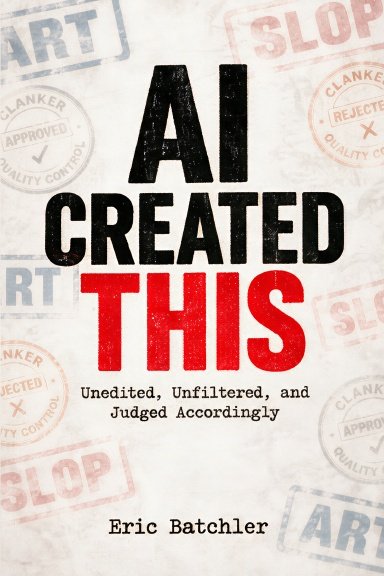
The digital world is currently caught in a fierce debate: Is generative AI a revolutionary tool for creating legitimate art, or is it simply a high-speed engine for flooding the internet with “slop”? It is a question that defines our current technological era. To find the answer, a unique experiment was launched with one uncompromising rule: nothing gets edited.
In a landscape where most AI-generated content is quietly polished by human hands before it reaches the public, this experiment sought to strip away the facade. By turning nine commercial AI tools loose across various sectors, from music and coding to social media and data centers, the project captured the raw, unfiltered output of today’s most advanced machines. The results were then compiled directly into a book, providing a transparent look at what happens when the machines are left to their own devices.
The Methodology: Zero Human Intervention
The core philosophy of this experiment was radical transparency. In the world of AI content, “prompt engineering” and “post-processing” are often used to hide the flaws of the underlying technology. For this project, those safety nets were removed. Whatever the machines produced went directly into print. There was no cleanup and no quiet polishing.
This “raw” approach is essential for understanding the true capabilities, and limitations, of generative AI. When we edit AI content, we are essentially “human-washing” the output, making it difficult to tell where the machine ends and the human begins. By enforcing a strict no-edit rule, this experiment offers a rare glimpse into the “soul” of the machine, showing us exactly what these tools are capable of when they aren’t being babysat by human editors.
Nine Tools, Four Domains
To provide a comprehensive overview of the current AI landscape, the experiment utilized nine different commercial AI tools. These tools were tasked with generating content across four primary domains:
- Music: Testing the ability of AI to capture rhythm, melody, and emotion.
- Coding: Evaluating the functional logic and structural integrity of machine-generated scripts.
- Social Media: Observing how AI navigates the nuances of engagement, trends, and digital communication.
- Data Centers: Exploring the more technical and logistical outputs of AI systems.
By spreading the experiment across these diverse fields, the project was able to test whether AI excels in creative endeavors, technical tasks, or if it struggles equally across the board. The goal was not to find the “best” tool, but to see how different machines handle the pressure of producing final, unedited work.
The Infamous “System Prompt” Leak
One of the most revealing moments of the experiment occurred when a blog-generation tool accidentally leaked its own internal system prompt directly into the live text. For those unfamiliar with the terminology, a system prompt is the underlying set of instructions given to an AI by its developers to govern its behavior and tone. It is effectively the “internal monologue” or the “rules of the road” for the AI.
In any other context, a human editor would have spotted this glitch and deleted it immediately to maintain the illusion of a seamless AI output. However, true to the rules of the experiment, it stayed in the book. This moment serves as a powerful reminder of the mechanical nature of these tools. It exposes the “glitch in the matrix,” showing readers the hidden logic that dictates how AI interacts with the world.
Claude as the Critic: AI Judging AI
Perhaps the most fascinating aspect of this project is the role of the narrator. Instead of a human providing commentary, the experiment employed Claude, an advanced AI, to act as the critic. Claude’s job was to evaluate the work produced by the other nine machines, providing a meta-commentary on the state of generative technology.
Claude’s role was twofold:
- The Evaluator: Identifying which machines “landed” their assignments and produced coherent, high-quality output.
- The Roaster: Fearlessly calling out the tools that completely “lost the plot,” producing nonsensical or low-quality “slop.”
This dynamic creates a unique feedback loop. We are not just seeing AI work; we are seeing an AI analyze that work with a level of brutal honesty that humans might shy away from. Claude’s critiques provide a framework for understanding the difference between meaningful machine creation and digital noise.
Art vs. Slop: The Ultimate Question
The transcript of the experiment poses a fundamental question: Are we witnessing the birth of a new art form, or are we just witnessing the industrialization of “slop”? By presenting the “actual work” of these machines without the fluff of theory or the shield of editing, the project allows the reader to decide.
When AI creates music or code, is it following a pattern, or is it creating something with “legitimacy”? The experiment suggests that the answer lies in the output itself. By looking at the unpolished results, we can see the moments of brilliance where the machine truly “gets it,” as well as the moments of failure where the logic breaks down into high-speed repetition.
Key Takeaways from the Experiment
- Transparency is Key: To truly understand AI, we must look at its unedited output. Editing hides the reality of the technology.
- System Prompts Matter: The “leaked” prompt incident highlights how much of an AI’s personality and output is dictated by its underlying developer instructions.
- AI is a Varied Field: Not all AI tools are created equal. Some “land” their tasks, while others fail spectacularly.
- The Power of AI Criticism: Using one AI to critique another provides a unique, objective perspective on the quality of generative content.
Conclusion: The Future of Machine Work
This experiment, now documented in a book created on Amazon, serves as a time capsule for the current state of generative AI. It is a raw, honest, and sometimes humorous look at what happens when we stop trying to make AI look perfect and instead let it show its true self. There is no theory here, just nine machines showing their work and one AI critic telling you what it really thinks.
Whether you see the result as a collection of legitimate art or a mountain of high-speed slop, one thing is certain: the era of unfiltered machine content is here. As we move forward, the lessons learned from this “no-edit” experiment will be crucial in helping us navigate a world where the lines between human and machine creativity continue to blur. If you want to see the future of AI, you have to be willing to look at it, glitches, leaked prompts, and all.
Website: https://EricBatchler.com