
Recommended Reading List & Resources
IF YOU ONLY READ 5
If you only have time for a handful of books, start here:
Who Will Do What by When? – Birgit Zacher & Tom Hanson
Clear commitments eliminate confusion and build trust in teams. Story-driven tools show how to get promises in writing and measure delivery.
The Inner Game of Tennis – W. Timothy Gallwey
Quiet the inner critic (“Self 1”) to let natural ability (“Self 2”) flow. Focus on process over outcome unlocks peak performance without force.
Be Useful: Seven Tools for Life – Arnold Schwarzenegger
Seven practical tools (vision, hard work, communication, resilience) build lifelong success. Real-world examples show how to turn purpose into action.
Heads-Up Baseball: Playing the Game One Pitch at a Time – Ken Ravizza & Tom Hanson
Stay present with routines and controllables during high-pressure moments. One-pitch-at-a-time focus beats overthinking and anxiety.
The Power of Negative Thinking – Bob Knight (with Bob Hammel)
Realistic worst-case planning builds mental toughness and focus. Coach Knight shows how controlled negativity outperforms blind optimism.
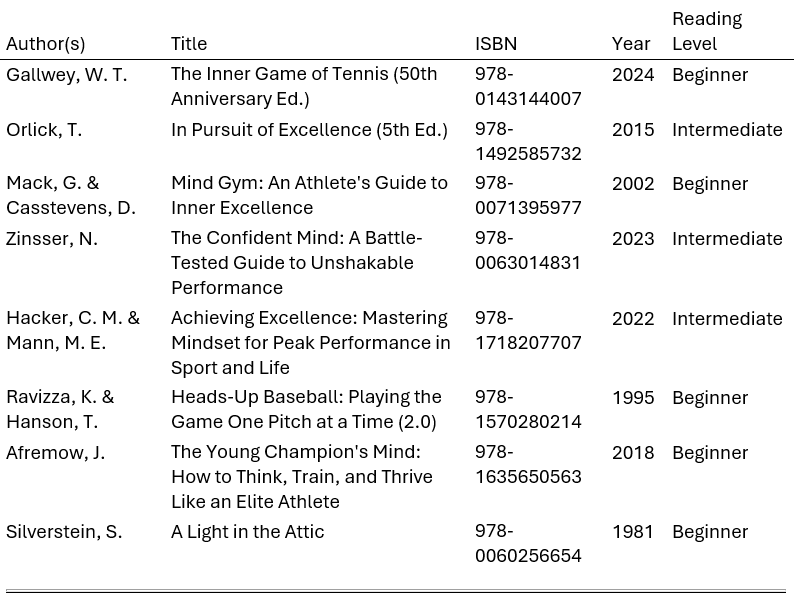
CLASSIC MENTAL PERFORMANCE & APPLIED SPORT PSYCHOLOGY
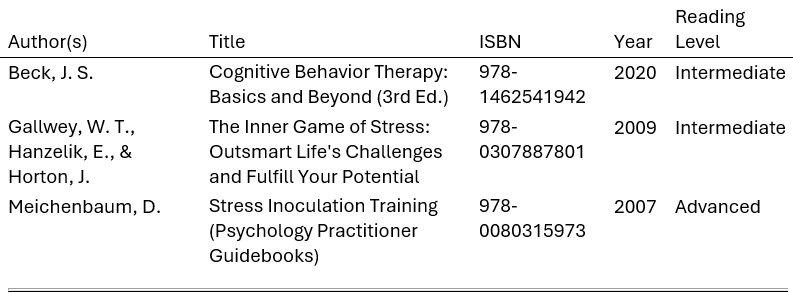
COGNITIVE BEHAVIORAL & STRESS MANAGEMENT FOUNDATIONS
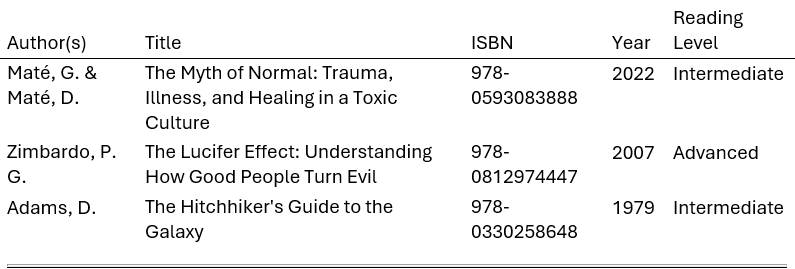
ETHICS, CULTURE & WELLBEING
FOUNDATIONAL SPORT PSYCHOLOGY TEXTBOOKS & REFERENCES
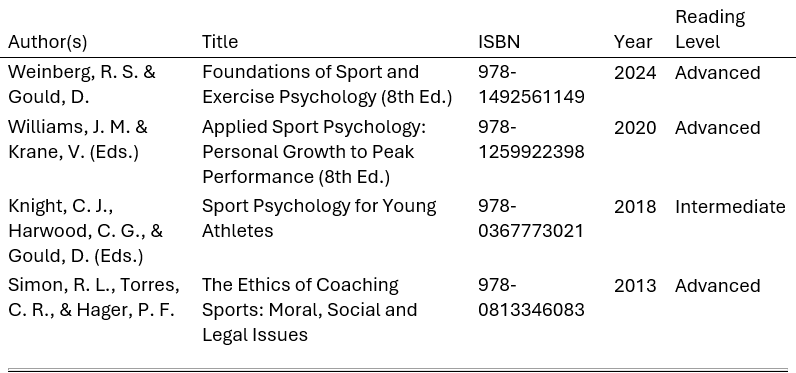
LEADERSHIP, ACCOUNTABILITY, PERFORMANCE & RESILIENCE
READING LEVEL GUIDE
Beginner – Story-driven, practical, minimal technical jargon. Ideal for athletes, parents, and coaches new to mental performance concepts. Focus on immediate application and narrative examples.
Intermediate – Blend of theory and practice. Assumes familiarity with basic psychological concepts but remains accessible. Good for a deeper understanding without full academic rigor.
Advanced – Academic or clinical in depth. Includes research foundations, statistical concepts, and professional-level detail. Best for coaches, mental performance consultants, and those seeking evidence-based rigor.
PODCASTS & ONGOING LEARNING
Podcasts
Unlocked: Mental Performance, Physical Results
· Hosted by Eric Batchler
· Applied episodes on mental performance, self-scouting, slump-busting, and play-for-fun vs. win-at-all-costs philosophies.
· Website: EricBatchler.com
Sane Enough
· Hosted by Eric Batchler·
· Focus on intracognism, internal dialogue, and reshaping unhelpful self-talk patterns.
· Website: EricBatchler.com
Featured Collaborator
IMAGiNE FiTTiNG IN™
· Hosted by Greg Jankowski
· Mental health awareness and wellness conversations; features guest appearance on therapy, culture, and mental strength.
Additional Mental Performance Media
Finding Mastery (Podcast)
· Hosted by Dr. Michael Gervais· Long-form interviews with elite performers on mindset, resilience, and high-pressure decision-making
High Performance Mindset (Podcast)
· Hosted by Dr. Cindra Kamphoff
· Practical tools on confidence, focus, and grit for athletes, coaches, and leaders
Becoming Wiser (Podcast)
· Hosted by Dr. Robert A. Rohm
· Focuses on personality styles, wisdom, and practical life/leadership insights to help listeners understand themselves and others and make wiser decisions.
Dr. Tom Hanson (YouTube: @DrTomHanson)
· Sport psychology videos on Heads-Up Baseball, Play Big philosophy, and mental performance tools
Eighty Percent Mental (Podcast)
· Featuring sport psychology professionals· Real-world applications of mental skills in sport and performance contexts
Trosky Baseball (YouTube: @Trosky365Live)
· Skills for Baseball and Life· Mental Performance Integrated
CITATIONS & ATTRIBUTION
This reading list is organized to support the evidence-based, practical tools, and ethical framework presented in the Capacity Series by Eric Batchler. The selections reflect research in sport psychology, cognitive-behavioral therapy, youth development, and performance ethics, as well as applied work that translates these concepts for athletes, families, and coaches. Although these works are not directly cited, they have influenced my perspective on mental performance. More importantly, they can enhance your understanding and practice of mental performance. Although not all sources may align with one another, it is essential to gather information from a diverse range of contributors. In the constantly evolving field of mental performance, knowledge is crucial for growth.